The Death of Vanity Metrics: Why TPS is a Lie
TPS measures sequencer bloat, not economic velocity. Account Abstraction breaks the legacy unit of measurement, and the Prism Intelligence Layer tracks the signal the rest of the market still misses: User Operations.


We are fighting the wrong war.
For the last cycle, Layer 1s and Layer 2s have competed on a single axis: Transactions Per Second (TPS). Every marketing deck flaunts a higher number, promising 10,000, 50,000, or even 100,000 TPS.
This is spam.
TPS has become a vanity metric that measures sequencer bloat rather than economic velocity. When a chain incentivizes bots to spam zero-value transactions to inflate their stats, TPS goes up. Real user value often stays flat.
We are measuring a supercomputer with a ruler made for a calculator.
The Shift to User Operations (UOPS)
The introduction of Account Abstraction changes the fundamental unit of blockchain economics. On networks like @Starknet, a single transaction hash is no longer a single action. It is a bundle.
One transaction can now contain:
1. Token Approval
2. Swap execution
3. Liquidity provision
Legacy metrics read this as 1 Transaction. The Prism Intelligence Layer reads this as 3 User Operations.
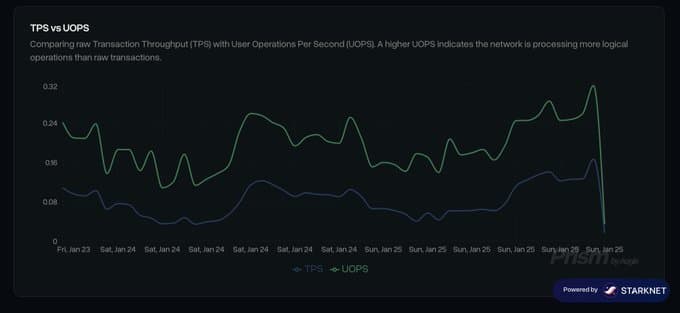
If you look at TPS, you see a clear misrepresentation of activity. If you look at UOPS, you see exponential density.
Prism Tracks the Signal
The Aegis Prism Intelligence Layer was built to ignore the noise of raw throughput and isolate the signal of intent. We found that while TPS fluctuates with bot activity, UOPS correlates almost perfectly with TVL retention and fee generation.
The era of “number go up” marketing is over. We are entering the era of execution density.
Stop optimizing for the road. Start optimizing for the cargo.